






Why Fintech’s AI Talent Pool Is Smaller Than It Looks

Artifical Intelligence, FINTECH | 5 min read READING TIME

POSTING DATE

category
Artifical Intelligence, FINTECH
 By Luc Simpson-Kent, Business Manager – Harnham
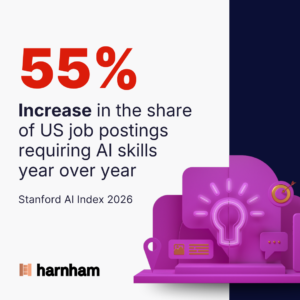
The share of US job postings requiring AI skills increased by 55% year over year, according to Stanford University’s 2026 AI Index.
For fintech hiring leaders, that signals a structural shift in the talent market. You’re no longer competing with other fintech companies alone. You’re competing with every organisation investing in AI while searching for a much smaller pool of professionals who can combine AI expertise with financial services experience.
As AI skills become a requirement across more industries, more employers are competing for the same technical professionals. Fintech narrows that talent pool even further by needing people who also understand regulated financial products, fraud, lending or payments.
The result is a smaller pool, longer hiring cycles and tougher competition for every critical hire.
AI demand is spreading across the US economy
The latest labor market data shows AI skills moving rapidly into mainstream hiring.
Stanford’s 2026 AI Index found that AI skills now appear in 2.5% of all US job postings, representing a 55% increase compared with the previous year. Rather than reflecting growth in specialist AI companies alone, it shows AI capability becoming embedded across a much wider range of occupations and industries.
The trend extends beyond the US labor market.
According to the World Economic Forum, citing LinkedIn data, the global economy has added 1.3 million AI-related roles over the past two years. AI Engineer is now one of LinkedIn’s fastest-growing job titles, while demand for AI literacy continues to grow across a broad range of technical and business functions.
Organizations that once competed for very different talent are now recruiting from the same market.
Healthcare providers are building AI teams. Manufacturers are investing in predictive automation. Retailers are expanding personalisation capabilities. Professional services firms are embedding generative AI into client delivery.
Fintech companies are competing for the same technical talent as all of them.
Why fintech faces an even smaller talent pool
The challenge for fintech isn’t simply finding AI professionals. It’s finding people who can apply AI within complex financial environments.
Many organisations are hiring for combinations of skills rather than individual disciplines. An AI engineer may also be expected to understand credit decisioning. A machine learning engineer may need experience building fraud detection models. A data scientist may need to work across compliance, risk and product while navigating regulatory requirements.
Every additional requirement narrows the available talent pool.
The strongest candidates combine AI engineering expertise with experience solving financial services problems such as fraud, credit risk or payments. Those profiles are considerably harder to find than general AI engineers.
Hiring successfully depends on knowing which skills can transfer into fintech and which roles genuinely require financial services experience.
The business impact of specialist AI hiring
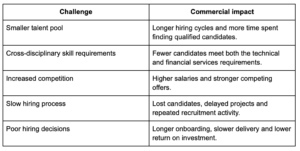
For fintech companies, the cost of a smaller AI talent pool goes well beyond recruitment. It affects how quickly teams can deliver, how much they spend to secure talent and how much value each hire brings to the business.
A single senior AI vacancy can stall a roadmap for months, and a mishire in a regulated environment carries a heavier cost than in most sectors: rework, compliance exposure and the salary already spent.
In a market where the strongest candidates move quickly, every week a role stays open is a week a competitor can use to close them.
Before you go to market, make sure your hiring expectations match today’s talent market.
Download Harnham’s US Data & AI Salary Guide for the latest salary benchmarks, hiring trends and market insights across AI engineering, machine learning, data science and data engineering roles.
Five ways fintech companies can compete for AI talent
Hiring successfully isn’t just about offering higher salaries. It’s about widening the talent pool, making better hiring decisions and moving faster than the competition.
1. Look beyond fintech
Hiring exclusively from fintech limits an already small talent pool.
Candidates from insurance, cybersecurity and healthcare may already have experience applying AI in highly regulated, data-intensive environments. In many cases, those skills transfer successfully into financial services.
The same machine learning skills used to build fraud detection models in insurance can often transfer into fraud prevention, credit risk and payments within fintech. Our blog, How Tri-State Insurers Are Using AI to Combat Rising Fraud in 2026, explores how insurers are embedding AI into fraud detection and the specialist talent driving that work.
Broadening the search creates access to more high-quality candidates without lowering the hiring bar.
2. Decide what’s essential
Many AI hiring briefs ask for everything: machine learning, software engineering, infrastructure, product knowledge and deep financial services experience.
Very few candidates meet every requirement.
Separate the skills that are essential from those that can be learned on the job. A more focused brief attracts a stronger and more realistic candidate pool.
3. Build as well as buy
Many organizations are developing AI capability within their existing engineering and data teams while hiring externally for the most specialist roles. That approach reduces long-term reliance on an increasingly competitive hiring market.
In the Scaling AI Capability in Insurance & Fintech whitepaper, Waseem Ali, CEO of Rockborne said:
The most successful data leaders understand that AI capability is a people challenge as much as a technology challenge. The organizations making progress are investing in skills, training, and workforce development alongside hiring.
Alongside specialist recruitment, Rockborne, part of the Harnham group, helps businesses develop practical AI, machine learning and data skills through structured training and upskilling programs. For roles where the external pool is thinnest, building the skill in-house is often faster than waiting for the perfect hire to appear.
4. Make hiring decisions faster
Experienced AI professionals rarely stay on the market for long.
Clear interview stages, timely feedback and faster decision-making let businesses secure the strongest candidates before competitors do. In a competitive market, speed is often the difference between making a hire and restarting the search.
5. Enter the market with current data
Understanding salary expectations, candidate availability, competing offers and typical hiring timelines allows businesses to plan realistically from the outset rather than adjusting budgets and expectations halfway through the process.
Winning AI talent requires a different hiring strategy
As AI adoption expands across every industry, competition for technical talent will continue to increase.
For fintech companies, the challenge is amplified by the need for professionals who combine AI expertise with an understanding of financial products, regulated environments and commercial risk.
Building successful AI teams requires more than access to candidates. It requires a clear understanding of where talent exists, how the market is evolving and which hiring strategies are most likely to succeed.
For more than 19 years, Harnham has specialized exclusively in Data & AI recruitment, helping organizations build high-performing technical teams across the US. Combined with market intelligence, salary benchmarking, specialist recruitment expertise and capability-building through Rockborne, we help businesses build practical hiring strategies for a market this tight.
Planning to grow your AI team? Speak to a Harnham specialist to discuss your hiring strategy and understand how today’s market is evolving.
By Luc Simpson-Kent, Business Manager – HarnhamThe most successful data leaders understand that AI capability is a people challenge as much as a technology challenge. The organizations making progress are investing in skills, training, and workforce development alongside hiring.
Share this article
Industry Hub
Related
articles
With over 10 years experience working solely in the Data & Analytics sector our consultants are able to offer detailed insights into the industry.
Visit our Blogs & News portal or check out our recent posts below.

What Does a Data Engineer Do?
A Data Engineer builds and maintains the systems and pipelines that collect, store and prepare data for…


How to Become a Data Engineer
The more companies invest in AI, the more they need people who can make their data usable…

How Much Does a Data Scientist Make?
Data Scientist salaries vary considerably by location, experience, sector and technical expertise. In the UK, salaries commonly…

What Does a Data Scientist Do?
A Data Scientist turns data into decisions. They use statistical analysis and machine learning to find patterns,…

How Much Does a Data Engineer Make?
Data Engineers in the UK typically earn between £31,000 at junior level and £100,000+ in senior and…

How to Become a Data Scientist
Becoming a Data Scientist is one of the most education-led routes in technology. It usually starts with…

What Does an AI Engineer Do?
What Does an AI Engineer Do? Job Description, Responsibilities and Skills AI Engineers turn artificial intelligence from…

How Much Does an AI Engineer Make?
How Much Does an AI Engineer Make? AI Engineers are among the most sought-after technology professionals in…

How to Become an AI Engineer
How to Become an AI Engineer AI Engineering is one of the fastest-growing careers in technology, combining…

Why Fintech’s AI Talent Pool Is Smaller Than It Looks
By Luc Simpson-Kent, Business Manager – Harnham The share of US job postings requiring AI skills increased…