






 by Jamie Smith, Senior Manager at Harnham, UK.
Data & Analytics Hiring Trends
How working models, technology choices, and assessments are changing hiring
These data and analytics hiring trends reflect how working patterns, technology choices, and assessment methods are changing across analytics roles, based primarily on hiring activity with Northern-based clients.
While many of these trends are not exclusive to the North, they reflect patterns we are consistently seeing across organisations hiring data and analytics talent in Northern England.
Let’s take a look at the key shifts influencing hiring decisions today, from hybrid working and low-code tools to Microsoft Fabric, marketing mix modelling, and technical assessments.
On this page
Hybrid working expectations in data and analytics roles
Hybrid working is no longer a differentiator for many data and analytics roles. For a significant share of professionals, some degree of flexibility is now expected as part of the role.
Across much of the market, candidates commonly look for one to two days per week in the office. While some larger organisations, particularly in banking and retail, continue to push for higher on-site attendance, this tends to narrow the available talent pool rather than expand it.
In practice, expectations vary by sector and region. For example, we are currently supporting a retailer in the Midlands and a financial services organisation in the Midlands that are both seeking candidates to be on site four to five days per week.
These models are typically more achievable for large, established employers with strong brand recognition, but they tend to reduce the available talent pool and extend hiring timelines compared to more flexible approaches.
Stricter office requirements are often associated with:
- Reduced access to candidates who have relocated or prioritise flexibility
- Longer hiring timelines as talent pools become more constrained
- Increased salary pressure to offset reduced flexibility
- Greater reliance on relocation packages or regionally limited hiring strategies
Hybrid working expectations now play a material role in hiring outcomes for data and analytics teams.
Employers with more rigid attendance requirements often need to compensate through pay, brand strength, or the nature of the work itself.
Low-code platforms in analytics teams
Low-code platforms are increasingly used in analytics and finance teams to accelerate delivery where engineering capacity is limited. In the short term, this can reduce dependency on specialist roles and improve speed to insight. Over time, the trade-offs become more visible.
We are seeing particularly strong uptake of low-code tools within financial services organisations, including a number of clients based in Leeds and Birmingham. In these environments, low-code platforms are often used to accelerate reporting and analytics delivery while managing engineering capacity and regulatory constraints.
Initial benefits typically include faster development cycles, broader accessibility for analysts, and lower upfront costs through built-in governance and security controls.
As adoption scales, teams often encounter:
- Reduced flexibility for complex or bespoke use cases
- Licensing costs that increase as usage expands
- A gradual erosion of in-house engineering capability
- Longer-term skills gaps that surface as platforms are pushed beyond their original scope
Decision point
Low-code tools can support near-term delivery goals, but hiring decisions need to account for long-term capability, maintainability, and technical depth.
Microsoft Fabric skills and hiring considerations
Microsoft Fabric is gaining traction primarily in organisations already operating within the Microsoft ecosystem. Hiring demand is less about the platform itself and more about whether teams can build capability without introducing cost or delivery risk.
We are increasingly seeing Microsoft Fabric referenced in role requirements across a range of industries. This is particularly noticeable in established data hubs such as Manchester, Cheshire, and Leeds, where organisations are building on existing Microsoft-based data estates and looking to consolidate analytics capability.
Interest is typically driven by the promise of a unified OneLake architecture, close integration with Power BI and Azure, and the continued expansion of AI-enabled features across the platform.
At the same time, employers frequently raise concerns around:
- Cost visibility and predictability at scale
- Platform maturity and the pace of product change
- The training investment required to build reliable capability
As a result, many roles reference:
- Power BI and Fabric experience
- OneLake architecture knowledge
- DP-600 and DP-700 certifications, often alongside demonstrable hands-on delivery
Fabric adoption is increasing, but hiring decisions are shaped as much by risk management and cost control as by platform capability.
Why marketing mix modelling is becoming a core analytics skill
Marketing mix modelling is appearing more frequently outside specialist teams, particularly in organisations adjusting to reduced access to user-level data.

Data & AI Podcast: How Incrementality and MMM Are Changing Marketing Analytics
Rather than replacing attribution entirely, MMM is increasingly used alongside other approaches to support decision-making where privacy constraints limit traditional measurement methods.
Demand is being shaped by:
- Cookie deprecation and iOS privacy changes
- GDPR and CCPA restrictions on data use
- A need for privacy-compliant ways to assess marketing effectiveness
From a commercial perspective, MMM supports:
- Marketing ROI analysis without reliance on personal data
- More disciplined allocation of large marketing budgets
- Decision-making that holds up under regulatory scrutiny
Marketing mix modelling is increasingly treated as a core analytics capability rather than a niche specialism, and is appearing more often in standard marketing analytics roles.
Why technical assessments are moving earlier in hiring processes
As hiring teams place greater emphasis on validating practical capability, technical assessments are being introduced earlier in the interview process. This shift is partly influenced by wider use of AI tools, but more directly by the cost of late-stage hiring mistakes.
Assessment formats increasingly reflect real working scenarios rather than theoretical exercises.
Typical examples include:
- Data analysts and analytics engineers
Live SQL tasks, Excel or Python exercises, dashboard interpretation
- Data scientists
Real-time coding, statistical reasoning, model evaluation, live notebook sessions
- Marketing analytics and MMM roles
Regression interpretation, p-values, causation versus correlation
- BI and visualisation roles
Dashboard critique and stakeholder scenario discussions
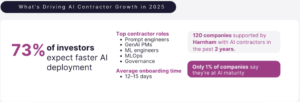
As hiring timelines tighten, many organisations are also reassessing how capability is resourced. In AI-focused teams, this has led to greater use of flexible delivery models, with some US companies scaling AI capability through contractors to meet delivery goals without adding long-term headcount risk.
Related read: Why US Companies are Scaling with Contractors
Earlier technical assessments allow teams to validate capability sooner, reduce late-stage risk, and make hiring decisions with greater confidence.
How Harnham can support hiring decisions
Across data and analytics teams, hiring challenges are rarely about volume alone. More often, they come down to how roles are defined, how teams are structured, and how capability needs to evolve as priorities change.
Harnham works with organisations and professionals across the full data and analytics lifecycle, supporting hiring decisions that reflect current market conditions rather than assumptions.
If you’d like to explore how these trends translate into team structure, role design, and delivery outcomes, you can learn more about our Data and AI Talent Solutions, covering permanent, contract, and project-based hiring.
Contact Harnham to discuss your data and analytics recruitment needs.