






Why US Companies Are Scaling AI with Contractors in 2025

Artifical Intelligence, Hiring Advice | 3 min read READING TIME

POSTING DATE

category
Artifical Intelligence, Hiring Advice
Artificial intelligence has arrived in the workplace and it’s changing how companies are structured, resourced, and scaled.
While nearly every business is investing in AI, McKinsey reports only 1% believe they’ve reached maturity. This suggests that leadership hesitation, not talent availability, is now the most common barrier to scaling AI.
To bridge the gap between ambition and action, companies are increasingly turning to AI contractors. These specialists allow businesses to scale fast, launch projects, and stay lean without compromising delivery or governance.
Here’s what recent reporting, investor sentiment, and Harnham’s hiring data tell us about why contractor models are accelerating in 2025.
1. The Rise of Specialist Contractor Models
Bloomberg reports that US companies are keeping their internal AI teams small and supplementing with contractors to drive execution. Rather than building full departments, they’re embedding niche experts, such as LLM engineers or RAG developers, to support high-impact delivery.
This model gives businesses flexibility to move fast, plug skill gaps, and reduce permanent headcount risk.
2. Companies Are Under Pressure to Deliver AI ROI
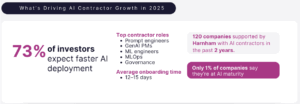
73% of investors expect companies to scale AI efforts this year, according to the PwC’s 2024 Global Investor Survey. That pressure is driving demand for immediate capability. Contractors offer a way to meet expectations now, without waiting for long internal hiring cycles.
The companies that are moving fastest aren’t necessarily the ones with the biggest budgets. They’re the ones with clear goals and flexible delivery models.
3. Contractors Fill the Gap Across Sectors
Over the last 24 months, Harnham has supported 120 companies across sectors like fintech, healthtech, private equity, and energy with AI contractor hiring. Roles span:
- Prompt engineers
- GenAI product owners
- ML engineers specialising in LLMs
- MLOps contractors
- AI governance analysts
These roles are critical to scaling pilot projects, delivering secure production systems, and building credibility with boards and investors.
Why Contractors Win in 2025
- Speed to deploy: Onboard in 12–15 days on average
- Access to niche skills: Fill gaps fast without over-hiring
- Flexible budgets: Pay only when work is happening
- Reduced risk: Scale teams up or down based on delivery needs
Looking Ahead
In the second half of 2025, investors are watching for measurable outcomes, and companies are under pressure to show that AI budgets are translating into business value.
We expect to see:
- More businesses formalising their AI governance policies
- Higher demand for short-term contractors with GenAI, LLM, and MLOps expertise
- Tighter timelines from project brief to delivery, particularly in financial services, healthtech, and retail
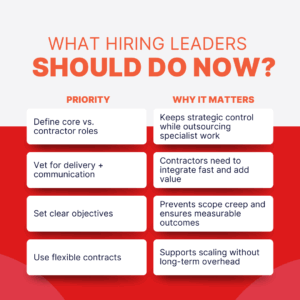
For hiring managers: define where you need flexibility, and build partnerships that can support quick mobilisation.
For AI specialists: demand remains high but the most in-demand contractors will be those who can work independently, communicate clearly, and deliver impact from day one.
Need Support Building Your AI Team?
Download our AI Hiring Guide — with practical advice on where to start, which roles to prioritise, and how to structure contract and permanent hiring around real business goals.
Or book a consultation with one of our US-based AI contract hiring specialists.
Or book a consultation with one of our US-based AI contract hiring specialists.
Share this article
Industry Hub
Related
articles
With over 10 years experience working solely in the Data & Analytics sector our consultants are able to offer detailed insights into the industry.
Visit our Blogs & News portal or check out our recent posts below.

Is your organisation ready for AI? What leaders need to assess before investing
61% of people are using AI in their current roles, yet only 37% of companies report having…


How Much Does a Data Analyst Make in 2026?
Whether you’re starting your career as a Data Analyst or thinking about your next move, knowing what…

What Does a Data Engineer Do?
A Data Engineer builds and maintains the systems and pipelines that collect, store and prepare data for…

How to Become a Data Engineer
The more companies invest in AI, the more they need people who can make their data usable…

How Much Does a Data Scientist Make?
Data Scientist salaries vary considerably by location, experience, sector and technical expertise. In the UK, salaries commonly…

What Does a Data Scientist Do?
A Data Scientist turns data into decisions. They use statistical analysis and machine learning to find patterns,…

How Much Does a Data Engineer Make?
Data Engineers in the UK typically earn between £31,000 at junior level and £100,000+ in senior and…

How to Become a Data Scientist
Becoming a Data Scientist is one of the most education-led routes in technology. It usually starts with…

What Does an AI Engineer Do?
What Does an AI Engineer Do? Job Description, Responsibilities and Skills AI Engineers turn artificial intelligence from…

How Much Does an AI Engineer Make?
How Much Does an AI Engineer Make? AI Engineers are among the most sought-after technology professionals in…