






AI in Private Equity: How Talent Strategy Drives Portfolio Value Creation

Artifical Intelligence | 4 min read READING TIME

POSTING DATE

category
Artifical Intelligence
Most PE firms are investing in AI, but returns remain mixed.
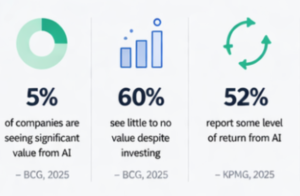
Research from KPMG shows that around 80% of organisations view AI as critical to competitive advantage, and just over half report some level of return. Alongside this, work from Boston Consulting Group suggests only around 5% are generating meaningful value at scale.
As AI becomes part of value creation strategies in private equity, the challenge is no longer whether to invest, but how that investment is delivered through people, skills, and structure inside portfolio companies.
On this page
- Where AI contributes to value creation in PE portfolios
- Why AI investment is not translating into ROI
- AI talent constraints in private equity
- Three common capability gaps across portfolio companies
- What leading firms are doing differently
- What this means for operating partners and portfolio CEOs
- How Harnham supports AI talent strategy in private equity
Where AI contributes to value creation in PE portfolios
AI is already influencing core value drivers across portfolio companies:
- Revenue growth: pricing optimisation, customer segmentation, demand forecasting
- Cost efficiency: automation, process improvement, resource allocation
- Decision-making: planning, forecasting, performance tracking
Many firms are investing in shared infrastructure across their portfolios, including KPI frameworks, centralised data platforms, and more consistent reporting. These efforts improve visibility, but they do not replace execution at the company level.
This directly affects how quickly value can be realised across the portfolio.
Portfolio infrastructure vs company execution
Layer
Focus
Outcome
Portfolio level
Reporting, KPIs, data platforms
Visibility
Company level
Pricing, operations, forecasting
Commercial impact
Why AI investment is not translating into ROI
Across PE portfolios, AI initiatives are being launched and use cases are being explored, but commercial outcomes are often limited or difficult to measure.
The issue is not access to tools, but how AI is applied and managed.
1. AI is not anchored to the value creation plan
AI activity often runs alongside the investment thesis rather than supporting it directly. That makes it harder to prioritise work, measure outputs, and connect AI to revenue or cost improvement.
2. Execution is fragmented
Even with central investment, portfolio companies often lack clear ownership of AI delivery, alignment between technical and commercial teams, and consistent prioritisation of use cases. This creates activity without coordination.
3. Leadership is unclear or introduced at the wrong time
As seen with analytics leadership, timing and mandate shape impact.
Hiring too early creates unclear roles.
Hiring too late leaves AI disconnected from decision-making.
AI talent constraints in private equity
AI delivery depends on people who can connect technical capability to business outcomes. This is becoming harder as the talent market tightens.
- Senior AI and data leaders remain in limited supply, particularly those with experience linking AI to commercial outcomes.
- Competition for experienced hires has increased
- Compensation expectations continue to rise
For a deeper look at how leadership roles evolve across PE portfolios, see our guide to analytics leadership in portfolio companies.
Three common capability gaps across portfolio companies
Even where hiring is successful, many PE-backed businesses struggle to translate capability into impact.
- Lack of senior ownership
No single leader accountable for how AI supports revenue, margin, or efficiency
- Misaligned hiring
Roles defined around tools rather than outcomes, leading to strong technical hires without clear direction
- Limited integration into operations
AI work remains separate from commercial and operational decision-making
How leading PE firms approach AI talent and delivery
Leading firms are embedding AI capability across portfolios and linking it directly to commercial outcomes. Firms that solve the talent gap are likely to capture a disproportionate share of value.
Area
Approach
What Changes
Link AI to value drivers
Start with where value is created and which decisions drive that value.
Apply AI to those areas.
AI supports revenue, cost, and operational priorities instead of running as separate initiatives
Embed capability in portfolio companies
Build AI and data capability within portfolio businesses, align roles to operating priorities, and support adoption at leadership level
Insights are used in day-to-day decisions, not left in reports or models
Hire for commercial impact
Prioritise profiles that understand revenue and cost drivers, can influence stakeholders, and can scale use cases
Technical work translates into measurable business outcomes
Structure talent across the hold period
Introduce interim or fractional leadership early, then move to permanent leadership once AI is tied to the value creation plan
Clear direction early on, with ownership as capability scales
What this means for operating partners and portfolio CEOs
If AI is not delivering the outcomes you expected, the issue usually comes back to a few things: role clarity, how capability is aligned to the business, and when leadership is introduced.
It’s worth stepping back and asking a few simple questions:
- How does AI support the value creation plan?
- Who owns delivery at company level?
- Are roles defined around outcomes or tools?
- How is impact measured commercially?
Gavin Geminde of KPMG:
The value creation angle here is really about delivering enhanced EBITDA using these tools. At the end of the day, integrating AI technology into all private equity playbooks will be key, and this will continue to evolve in the years to come.
How Harnham supports AI talent strategy in private equity
Harnham works with private equity firms and portfolio companies to improve execution and speed to impact.
- Define data and AI leadership roles aligned to value creation plans
- Benchmark hiring strategy against growth stage, market conditions, and portfolio objectives
- Introduce interim or permanent talent to accelerate delivery across the portfolio
Contact Harnham for Data Talent support
If you are reviewing how AI is delivered across your portfolio, or where capability gaps are affecting outcomes, speak to a Harnham specialist.
Portfolio infrastructure vs company execution
Hiring too late leaves AI disconnected from decision-making.
No single leader accountable for how AI supports revenue, margin, or efficiency
Roles defined around tools rather than outcomes, leading to strong technical hires without clear direction
AI work remains separate from commercial and operational decision-making
Apply AI to those areas.
The value creation angle here is really about delivering enhanced EBITDA using these tools. At the end of the day, integrating AI technology into all private equity playbooks will be key, and this will continue to evolve in the years to come.
Author

Share this article
Industry Hub
Related
articles
With over 10 years experience working solely in the Data & Analytics sector our consultants are able to offer detailed insights into the industry.
Visit our Blogs & News portal or check out our recent posts below.

Is your organisation ready for AI? What leaders need to assess before investing
61% of people are using AI in their current roles, yet only 37% of companies report having…


How Much Does a Data Analyst Make in 2026?
Whether you’re starting your career as a Data Analyst or thinking about your next move, knowing what…

What Does a Data Engineer Do?
A Data Engineer builds and maintains the systems and pipelines that collect, store and prepare data for…

How to Become a Data Engineer
The more companies invest in AI, the more they need people who can make their data usable…

How Much Does a Data Scientist Make?
Data Scientist salaries vary considerably by location, experience, sector and technical expertise. In the UK, salaries commonly…

What Does a Data Scientist Do?
A Data Scientist turns data into decisions. They use statistical analysis and machine learning to find patterns,…

How Much Does a Data Engineer Make?
Data Engineers in the UK typically earn between £31,000 at junior level and £100,000+ in senior and…

How to Become a Data Scientist
Becoming a Data Scientist is one of the most education-led routes in technology. It usually starts with…

What Does an AI Engineer Do?
What Does an AI Engineer Do? Job Description, Responsibilities and Skills AI Engineers turn artificial intelligence from…

How Much Does an AI Engineer Make?
How Much Does an AI Engineer Make? AI Engineers are among the most sought-after technology professionals in…